


Introduction: Why a Student’s Morning Routine Changes Everything?

Most students don’t struggle because they are lazy or incapable. They struggle because their day starts without direction.
The first hour after waking quietly sets the tone for everything that follows. Focus, energy, and even confidence are heavily influenced by how that time is used. A rushed, reactive morning leads to distraction and low productivity. A structured start creates clarity and control.
This is why the best morning routine for a student is not about forcing a 5 AM wake up or copying someone else’s schedule. It is about aligning your habits with how your brain naturally performs at its best. When your routine supports your biology, studying becomes easier, not harder.
A well designed morning routine for students can sharpen concentration, improve memory retention, and reduce stress before the day even begins. Instead of feeling overwhelmed by classes and assignments, you step into the day prepared.
This guide breaks down a science backed student morning routine that is simple, practical, and built to improve how you study, think, and perform consistently.
Table of Contents
Section 1: What Is the Best Morning Routine for a Student?

At its core, the best morning routine for a student is not complicated. It is a structured sequence of small, intentional habits performed after waking.
These habits are designed to prepare your brain and body for the demands of the day. When done consistently, they create a reliable system that supports focus, energy, and academic performance.
A strong morning routine for students focuses on a few key principles
- Consistency over perfection
Repeating simple habits daily matters more than creating a perfect schedule you cannot follow - Simplicity over complexity
The routine should be easy to start and easy to maintain
The most effective student morning routine is built around three essential components
- Physical activation
Light movement or exercise to wake up the body and improve brain function - Mental clarity
Simple practices like planning, journaling, or quiet reflection to reduce stress and sharpen focus - Deep academic focus
Dedicated time for studying when the brain is naturally most alert
When these elements come together, they form a healthy morning routine for students that does more than just start the day. It builds momentum, discipline, and a clear path toward better performance in school.
This is also where simple systems like the 3 3 3 rule for productivity can fit naturally into your routine. By focusing on a few high priority tasks instead of overwhelming yourself, you turn your morning into a structured and intentional start rather than a chaotic one.
Section 2: Core Principles Behind an Effective Student Morning Routine

A powerful morning routine for students is not built on motivation. It is built on repeatable principles that work with your brain, not against it. Get these right, and the rest of your routine becomes easier to follow and far more effective.
2.1 Consistent Wake Up Time and Sleep (5:30 to 6:30 AM)
Sleep is the foundation of every high performing student morning routine. Without it, even the best habits fall apart.
- Aim for 8 to 10 hours of sleep to support memory, focus, and learning
- Wake up at a consistent time each day to stabilize your internal clock
- Avoid the snooze button since it fragments sleep and causes grogginess
- A stable circadian rhythm helps your brain feel alert at the right time and improves overall energy
When your sleep is consistent, your study routine for students morning becomes smoother and more productive without relying on willpower.
2.2 Evening Preparation for a Stress Free Morning
A great morning actually begins the night before. Preparation removes friction and makes your routine automatic.
- Pack your school bag and organize materials
- Set out clothes to avoid morning decisions
- Write your top 3 priorities for the next day
- Create a simple plan for your study session
This reduces decision fatigue and allows your brain to focus on execution instead of thinking. It is one of the most overlooked best morning routine habits for students.
2.3 Light Exposure and Natural Wakefulness
Your body is designed to wake up with light. Using this natural trigger can instantly improve alertness.
- Get sunlight within the first 10 to 20 minutes after waking
- Open windows or step outside briefly
- Natural light signals your brain to stop producing melatonin
This simple habit regulates your body clock and helps you feel awake without needing excessive stimulation. It is a key part of a healthy morning routine for students.
2.4 No Phone Rule in the First Hour
The fastest way to lose control of your morning is to start scrolling.
- Avoid social media and notifications immediately after waking
- Prevent early dopamine spikes that reduce focus later
- Protect your attention for meaningful work like studying
Delaying phone use helps you stay intentional and focused. It allows your morning routine for students to build momentum instead of distraction.
Section 3: The Ideal Morning Routine for Students (Step by Step Schedule)
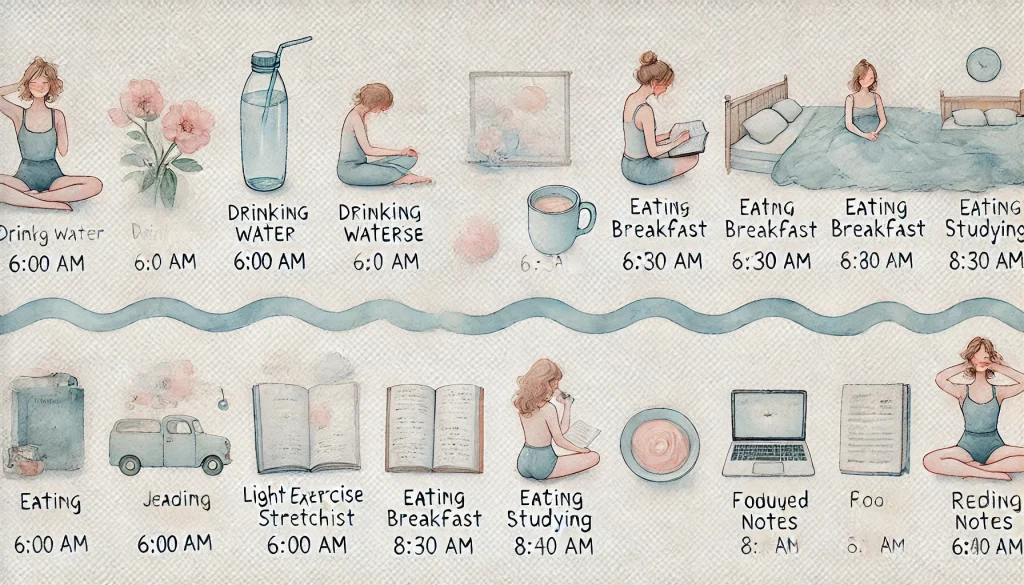
The best morning routine for a student is not random. It follows a structured flow that activates the body, clears the mind, and uses peak focus hours for studying.
Here is a simple 2 to 3 hour student morning routine designed for maximum productivity.
3.1 6:00 AM Wake Up and Hydrate
Start your day by waking up and drinking around 500 ml of water.
- Rehydrates the brain after sleep
- Boosts metabolism and improves focus
- Helps you feel alert without relying on caffeine
This small step sets the tone for an effective morning routine for students.
3.2 6:05 to 6:25 AM Light Exercise
Engage in light physical activity to wake up your body.
- Stretching
- Yoga
- Walking
- Simple body movements
Benefits
- Releases BDNF which supports learning and memory
- Improves blood flow to the brain
- Enhances cognitive performance
Movement is one of the most powerful best morning routine habits for students.
3.3 6:25 to 6:45 AM Protein Rich Breakfast
Fuel your body with a balanced breakfast focused on protein.
- Eggs
- Oats
- Yogurt
- Nuts
- Fruits
Benefits
- Provides stable energy for classes and studying
- Prevents mid morning crashes
- Supports brain function and concentration
A proper meal is essential for a healthy morning routine for students that actually sustains performance.
3.4 6:45 to 6:55 AM Mental Clarity Ritual
Take a few minutes to organize your thoughts before starting work.
- Write your top 3 goals for the day
- Practice gratitude or journaling
- Meditate briefly
- Review your plan
Benefits
- Reduces stress and mental clutter
- Builds focus and intention
- Prepares your brain for deep work
This step connects your routine to purpose, making your student morning routine more intentional.
3.5 6:55 to 8:25 AM Deep Study Session
This is the core of your study routine for students morning. Use this time for your hardest subject.
- Focus on one challenging topic
- Use Pomodoro method
- 25 minutes study
- 5 minutes break
- Repeat 3 times
Why it works
- Takes advantage of peak morning cortisol levels
- Improves deep focus and understanding
- Builds consistency in studying
This is where the best morning routine for a student delivers real academic results.
3.6 8:25 to 8:40 AM Active Recall Review
End your session by testing what you learned.
- Quiz yourself without looking at notes
- Recall key concepts from memory
- Avoid passive re reading
Benefits
- Strengthens long term memory
- Improves retention significantly
- Helps identify weak areas quickly
Active recall turns studying into learning, making your morning routine for students far more effective than traditional methods.
This is what separates average habits from truly good morning routines. Instead of just going through the motions, you are actively training your brain to understand, retain, and apply what you study.
Section 4: The Science Behind the Best Morning Routine for Students

A great routine is not built on guesswork. The best morning routine for a student works because it aligns with how the brain and body naturally function. When you understand the science, your habits stop feeling forced and start feeling effective.
4.1 Cortisol and Peak Focus in the Morning
Your brain is wired to focus best in the early hours of the day.
- Cortisol naturally peaks in the morning, increasing alertness and mental clarity
- This is when your brain is most ready for problem solving and learning
- Studying during this window improves understanding and retention
This is why a structured study routine for students morning can feel easier than studying late at night. You are working with your biology, not against it.
4.2 Hydration and Brain Performance
After several hours of sleep, your body wakes up slightly dehydrated. Even mild dehydration can affect how your brain performs.
- Reduces attention span and concentration
- Slows down memory recall
- Increases mental fatigue
Drinking water early in your student morning routine helps restore optimal brain function. It is one of the simplest yet most powerful habits in a healthy morning routine for students.
4.3 Exercise and Cognitive Function
Movement does more than wake up your body. It directly improves how your brain learns.
- Exercise releases BDNF, a protein that supports brain growth and learning
- Improves neural connections linked to memory and focus
- Enhances mood and reduces stress
Even light activity like stretching or walking can significantly boost cognitive performance. This is why exercise is a core part of the best morning routine habits for students.
4.4 Nutrition and Energy Stability
What you eat in the morning determines how you think for the next few hours.
- Protein helps stabilize blood sugar levels
- Prevents energy crashes during classes
- Supports sustained concentration and mental clarity
A balanced breakfast is essential for maintaining focus throughout the day. It strengthens your morning routine for students by providing steady energy instead of short bursts followed by fatigue.
Section 5: Practical Tips to Build a Morning Routine That Sticks

The biggest mistake students make is trying to build the perfect routine overnight. The truth is, the best morning routine for a student is the one you can repeat consistently.
Here is how to make your routine sustainable
- Start small with habit stacking
Attach new habits to existing ones like drinking water after brushing your teeth - Track your habits for around 66 days
Consistency over time helps turn actions into automatic behaviors - Keep your routine flexible
Allow lighter versions on weekends or Sundays to avoid burnout - Adjust timing based on your schedule
Your student morning routine should fit your school or college hours, not fight against them - Focus on consistency, not perfection
Missing a day does not matter. Returning the next day does
When built gradually, a morning routine for students becomes less of a task and more of a system. Over time, it shapes discipline, improves focus, and supports long term academic success.
It also helps fix low energy in the morning by aligning your habits with how your body naturally wakes up, making you feel more alert and ready to focus without relying on constant motivation.
Section 6: Common Mistakes Students Make in Their Morning Routine

Even the most motivated students can ruin their mornings without realizing it. Not because they lack discipline, but because small habits quietly pull their focus in the wrong direction.
One of the biggest mistakes is using the phone immediately after waking. The moment you start scrolling, your brain shifts into a reactive state. Attention gets fragmented, and by the time you sit down to study, focus already feels harder than it should.
Skipping breakfast is another common issue. Without proper fuel, energy drops quickly, and concentration suffers. This weakens your study routine for students morning, making even simple tasks feel mentally exhausting.
Many students also rely on passive studying like re reading notes. It feels productive, but it does not challenge the brain. Without active recall, information fades quickly, no matter how long you study.
An inconsistent sleep schedule adds another layer of difficulty. Waking up at different times every day disrupts your internal rhythm, making it harder to feel alert and focused in the morning.
Finally, trying to do too much at once often leads to burnout. A complicated routine might look impressive, but it rarely lasts. A simple, consistent student morning routine will always outperform an overloaded one.
The goal is not to avoid every mistake perfectly. It is to remove the habits that weaken your mornings so your routine can actually support your focus and performance.
Conclusion: The Real Secret to the Best Morning Routine for Students

The biggest misconception about mornings is that success comes from waking up earlier. It does not.
The best morning routine for a student is about starting the day with intention. It is about choosing actions that prepare your mind and body for what matters most.
Small, consistent habits create powerful results over time. When your mornings include movement, clarity, and focused study, your ability to learn and perform improves naturally. Focus becomes easier. Memory becomes stronger. Discipline becomes automatic.
You do not need a perfect schedule. You need a system you can repeat.
Because in the end, the best morning routine for a student is not the one that looks impressive. It is the one that quietly works every single day, making success feel less like effort and more like momentum.
1. What is the best morning routine for a student?
The best morning routine for a student includes simple, consistent habits that improve focus and energy. This usually involves waking up at a fixed time, drinking water, light exercise, a healthy breakfast, and a focused study session. The goal is not to do everything perfectly, but to follow a routine that supports learning and concentration every day.
2. How long should a student morning routine be?
A student morning routine typically lasts between 1.5 to 3 hours, depending on the schedule. Even a shorter routine can be effective if it includes key habits like hydration, movement, planning, and focused study. What matters most is consistency, not duration.
3. Is studying in the morning better for students?
Yes, studying in the morning is often more effective because the brain is naturally more alert. Higher cortisol levels in the morning improve focus and memory, making it the best time for deep learning and difficult subjects. This is why a strong study routine for students morning can significantly improve academic performance.
4. What should students avoid in their morning routine?
Students should avoid using their phone immediately after waking, skipping breakfast, and relying on passive studying like re reading notes. These habits reduce focus, energy, and retention. A clean and intentional morning routine for students helps avoid these common mistakes.
5. How can students stay consistent with a morning routine?
Students can stay consistent by starting small, building habits gradually, and keeping the routine simple. Tracking progress and allowing flexibility also helps maintain consistency. The best morning routine for a student is not perfect, it is repeatable and easy to follow daily.


